The Family Recovery Capital Framework
Updated: Mar 19
October 2025 Authors: Shelley Duffy, David Best, Kevin McInerney, Helen Thompson, Dot Smith,
Viv Evans, Robert Stebbings, William White
Overview
In 2024, Adfam published their report “Above and beyond” highlighting the
positive experiences of family support people in recovery recounted across
various key stages and domains of their recovery journey. Families matter. Yet
this comes at a cost – to the person in recovery in terms of feelings of shame,
stigma and guilt, and for the families often at huge emotional, financial and
psychological distress. Addiction is a form of trauma for families and the
recovery process charted for those overcoming their own addictions is much
more weakly conceptualised and evidenced in terms of the recovery journeys
of whole families. In this paper, we use data from three different research
projects, including the Adfam report, to generate a model of holistic family
recovery – the Family Recovery Capital Framework (FRCF).
Background and Rationale
STAR Recovery has partnered with three organisations in preparation of this
report in an attempt to deploy the framework for recovery capital to families.
Recovery capital has been defined as“the breadth and depth of internal and
external resources” available to support an individual in their recovery journey
(White, & Cloud, 2008, p.1). The recovery capital model has been increasingly
used as the metric of recovery support services to demonstrate the growth in
strengths individuals experience in their recovery journey. Our goal in this
project is to utlilise that approach – strengths-based, holistic and inclusive – to
improve our understanding of recovery as a family concept. This is based on the
idea that addiction is a form of trauma that impacts not only individuals but
whole families, and that the family will have its own journey, which can be
viewed as a form of post-traumatic growth, related to but separate from the
recovery journey of the individual with the addictions issues.
Methods
For this programme of work, the STAR Research team worked with three
organisations all of whom are committed to providing a holistic and
strengths-based approach to helping individuals and families overcome
addiction problems:
Adfam (https://adfam.org.uk) is the leading charity in England for all the
millions of people affected by someone else's drinking, drug use or gambling.
In 2024, Adfam had published its “Above and Beyond” report based on the role families played in supporting recovery journeys, as reported by people in recovery. We used a secondary analysis of that dataset for this project, based on a survey of 90 people who described themselves as “being in recovery or recovered”.
PROPS Family Recovery Service (https://props.org.uk) provides support to
people whose lives are affected by someone else’s drug and alcohol use in two
areas of the North-East of England- Newcastle and North Tyneside. Data were
drawn from a service evaluation of the PROPS Family Recovery Service in
Newcastle and North Tyneside conducted by STAR Recovery involving
secondary analysis of routine data collection around client wellbeing and focus
groups with the board of PROPS, staff and people who used their services in
both areas.
Recovery Connections (www.recoveryconnections.org.uk) provides recovery
support services in seven areas across the North-East of England and is a
founding member of the College of Lived Experience Recovery Organisations.
Recovery Connections commissioned STAR Recovery to conduct a needs
assessment to measure the level of provision and need of support for affected
others in Middlesbrough. A survey was completed by service users, capturing
family composition, and family support needs, supplemented with focus groups
across residents of the residential rehabilitation service, online participants,
women’s groups, community members, and Recovery Connections staff.
What is presented below is a brief overview of the findings from each study
followed by a synthesis into an integrated model for a Family Recovery Capital
Framework (FRCF).
Adfam Findings
Adfam: Of the 90 respondents, 72 (80%) reported at least one family member
involved in their recovery, while 18 (20%) indicated minimal or no family
support. Among those with family involvement (n = 72), support was
multidimensional. Emotional encouragement was most commonly reported
(80.6%), followed by practical help (55.6%), housing assistance (40.3%),
childcare (38.9%), and financial contributions (52.8%). There was also a
pronounced gendered pattern in caregiving roles. Mothers were the most
frequently cited source of support (54.2%), followed by female partners/ex-
partners (29.2%), followed by sons (26.4%), fathers (25%) daughters (22.2%)
and sisters (22.2%).
However, the qualitative data suggested that family involvement was not
always seen as universally beneficial, particularly in the early stages of
recovery, with one respondent reporting that it “Made things worse. Lack of
understanding”. There was also evidence that, while there was a need for
family support, it was rarely accessed — only 22.2% of participants reported
that their family had accessed structured education about addiction. Among
families without structured support (75%, with 2.8% unsure), 78.8% indicated
they would have liked it, and 86.5% believed it would have helped.
PROPS Findings
PROPS: Quantitative data collected using the Carer Support Outcomes Profile
CSOP) indicated that:
Carers entered the family support service with moderate knowledge of substance use effects
Relationships with substance-using relatives were characterised by low trust and high levels of conflict
Relationships with other family members were considerably stronger, with higher ratings of trust, communication and support
Carers reported high levels of anxiety, low mood, disrupted sleep and difficulties managing stress
Carers also had relatively low confidence dealing directly with their relative and reported low engagement with peer support
From the qualitative data, the carers were universally positive about the family
support service — one person reporting that “It gave me the confidence and the
knowledge to be able to say no, to be able to say I’m not putting up with that anymore.
”Family support offered information about substance use and helped cultivate carers’ ability to make informed decisions and establish healthy boundaries. Involvement with PROPS also generated a sense of belonging and peer support, as exemplified by “I feel like I belong here, and that’s not something I’ve felt for years”. This was reflected in the impact on the family dynamic —“We could all talk more easily with each other”

The support derived from peer group involvement was seen to strengthen
carers’ own wellbeing and had a ripple effect on the family holistically, improving communication, trust, and cohesion. There was also the benefits of learning how to manage the process from the staff at PROPS and from others ’experiences, exemplified in the statement that “Even when things go wrong, I know I’ve got tools and support to keep going.”
This was essential as families reported the cumulative effects of stress and
burnout — “I was exhausted, and I felt like there was nothing I’d go on that I
could stop,” something that was particularly strongly felt by female caregivers
“I was the one who was trying to hold everybody together”. The PROPS data demonstrated the benefits of personal and social growth through peer and professional support, and showed that family recovery was a journey over time.

Recovery Connections Findings
Recovery Connections: Consistent with the Adfam data, family members of
Recovery Connections services only rarely accessed support for themselves.
The survey and focus groups were able to explore the reasons for this. Key
barriers to support included lack of awareness (70.6% participants, 57.1%
family members), difficulty accessing support (58.8% and 42.9%), stigma
(58.8% and 42.9%), and fear of social services involvement (47% and 28.6%).
More than half (53.5%) reported actively avoiding support due to fear of social
services involvement, mainly over fear of losing children, being judged, or lack
of understanding from professionals. One participant reported that “Women
are scared to ask for help because then, boom, they’re coming to take your
children away”.
Even where there was awareness (and perceived need), engagement was low.
53.3% were aware of parenting classes and over half identified a need, but only 18.2% had attended. Similar gaps were observed for family therapy, SMART Family and Friends support, and family mediation. People in recovery saw education and awareness for family members as essential to address some of these gaps, as indicated by one participant who said “Families don’t understand addiction — it’s not just about stopping; it’s a disease”. Gender- and child-specific supports were particularly important, including childcare provision, women-only meetings, and preventative parenting interventions: “You’re educating the parent on a parenting course...when it’s too fucking late basically”.

Developing a Family Recovery Capital Framework
Five key themes were identified through the synthesis process that brought together the three datasets.
1. Relational Trust, Communication and Asynchronous Recovery.
Families across all three datasets described strained or fractured relationships,
characterised by low trust and poor communication, particularly in the early
stages of recovery. There is also asynchronous recovery, where family healing
typically progresses more slowly than individual recovery.
2. Emotional Strain, Burnout and Gendered Caregiving Burdens.
A consistent theme was the emotional toll of caregiving, often marked by
exhaustion, stress and invisibility, particularly for female caregivers.
3. Emotional Strain, Burnout and Gendered Caregiving Burdens.
Families identified limited understanding of addiction and recovery as a barrier.
4. Belonging, Reciprocity and Ripple Effects Positive recovery experiences were consistently characterised by belonging,
reciprocity, and ripple effects across families, where family recovery capital both sustains and multiplies through shared growth.
5. Systemic Barriers and Service Gaps
Finally, all three datasets highlighted systemic barriers to effective family
support, including lack of resourcing for family services, limited availability of
family interventions, stigma, fear of child removal and inconsistent service
provision.
From these themes we have developed the Family Recovery Capital Framework
(FRCF) in which families accumulate resources, which reinforce the recovery
process. In early stages, family involvement is often limited, cautious, or
inconsistent, particularly when relationships have been strained by substance use,
conflict, or trauma. Over time families with adequate support can contribute
positively to recovery and can undertake their own journeys of recovery.
The FRCF identifies five domains of family recovery capital, which map onto
traditional recovery capital constructs.
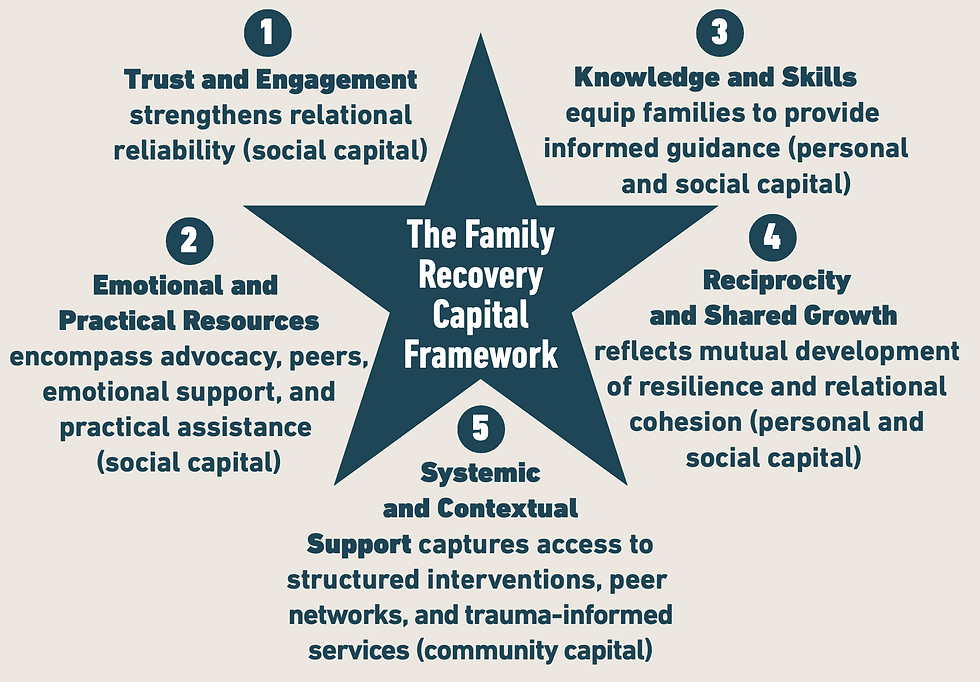
While these domains can be mapped against the standard recovery capital
domains of personal, social and community capital, we will start the process of
developing measurement methods for these five domains. This will be based
on the assumption that (as outlined in Cloud and Granfield, 2008) there will be
negative and positive dimensions to each of these domains. In spite of this, the
overall goal is not only to have a mapping process that accurately captures
family recovery capital, but pathways to interventions in each domain that can
strengthen each area of family recovery capital.
Next steps and implications
Our first aim is to disseminate these findings and generate support and
consensus for this work. We will then look to develop metrics and measures
for family recovery capital that can provide a systematic and scientific basis
for linking families to particular kinds of interventions and supports. The
partners will continue to work together to raise awareness of family recovery
needs and issues and to develop a model for integrating and testing recovery
pathways for families in the UK and internationally.
References
Adfam. (2024). Above and beyond: The key role families play in recovery. Adfam.
2024.pdf
Cloud, W. and Granfield, W. (2008). Conceptualizing recovery capital: expansion of a
theoretical construct. Substance Use and Misuse, 43(12-13), 1971-86.
White, W. and Cloud, W. (2008). Recovery Capital: A primer for addiction
professionals. Counsellor, 9(5), 22-27.



Comments