Recovery in justice and community settings in Auckland, New Zealand
Prof David Best
March 2026
Background: I am fortunate enough to have been to New Zealand on a number of previous occasions (generally when I was living in Australia) and I have always loved spending time in the country, in part because it is a beautiful and temperate place to be and partly because there are so many innovators inspired and motivated towards strength-based and recovery approaches. It seems, in significant part, because of the important role that Maori culture plays in creating a collectivist culture that is congruent with community-focused and strength-based approaches.
Drug Courts: It was a pleasure to be invited to this prestigious event hosted by the Law School at the University of Auckland.
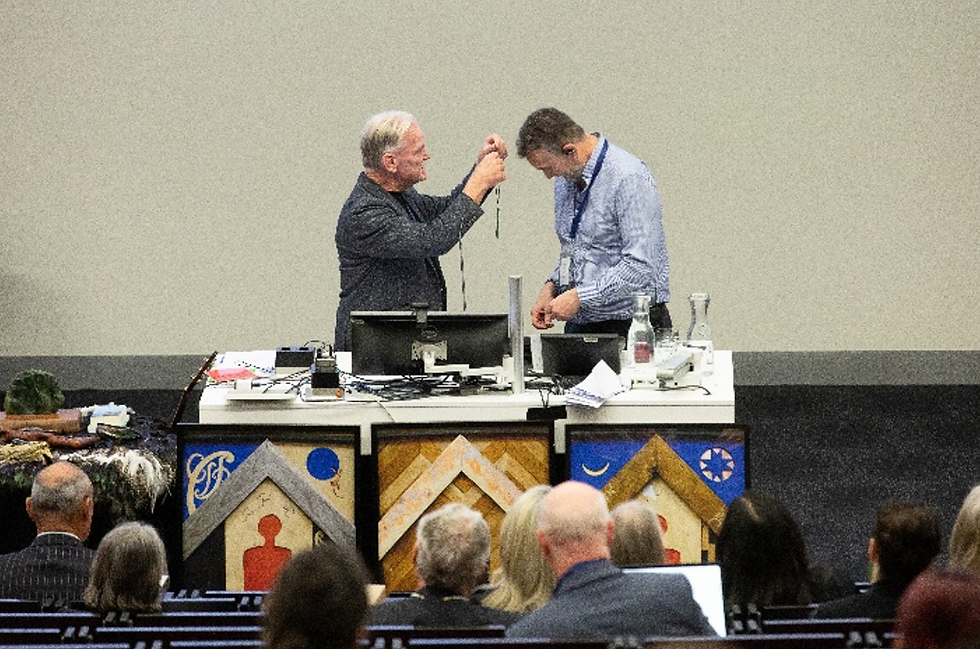
The photo captures what was the highlight of this trip for me – being presented with a Mere – a traditional Maori short sword – that I wear with pride around my neck . Not least because it was presented to me by Dave Burnside, a recovery leader and champion in Auckland and someone who I am proud to call a friend. The presentation was made after I spoke at the AODTC (Alcohol and Other Drug Treatment Courts) conference in Auckland. This was an international conference that celebrated what is possible in justice settings where the principles of evidence-based practice are combined with an ethos and commitment to building a culture of hope and belief in recovery and desistance from offending.
The mere is a form of taonga, and probably the most common taonga is the ‘toki’ which is usually in recognition of hard work. It is for the warrior. But the mere is for the rangatire, the chief, the leader. I was given this in recognition of my recovery role in New Zealand and around the world.

Every time I have been to New Zealand I have been greeted warmly and with considerable kindness, and my presentations (and there were four on this trip) seem to strike a chord with the audiences and particularly with those involved in Maori and Pasifika treatment and recovery services. Why should this be? I think it is at least in part because typical drug and alcohol treatment (involving medicines and psychosocial interventions generally delivered on a one-to-one basis) is a transactional western concept based on expert status (underpinned by a series of positivistic assumptions) that contrasts with a recovery model that is inherently social, about communities and belonging. The notion of reciprocity and mutuality is at the heart of the recovery movement and it is about caring and giving as much as healing and receiving.
Coincidentally, I have been reading recently about a mental health recovery concept called ‘Mattering’ (Rosenberg and McCullough, 1981) which has been described as feeling valued and adding value (Prilleltensky, 2014). Across four domains – community, work, relationships and self – the idea is that recovery is a process of both giving and receiving, and that helping others is inherent and intrinsic to the recovery process. In the drug court model in New Zealand, recovery is a process of connection and belonging and those concepts were fundamentally connected to culture and community.
Therapeutic Communities: The other major conference that I spoke at was the ATCA conference (Australasian Therapeutic Communities Association) where I had the chance to revisit a theme about that has been highly influential in my work and that is around social identity and the importance of group belonging on recovery sustainability. Between 2012 and 2015, I led an Australian Research Council study examining the impact of identity on recovery outcomes in a group of 300 people who had been recruited on entry to one of five Therapeutic Communities in Australia. As we had predicted in our Social Identity Model of Recovery (Best et al, 2015), the greater the growth in recovery identity, the stronger the growth of recovery outcomes. At six months after admission to the Therapeutic Community, there was a clear benefit for adopting a recovery identity (Haslam et al, 2014) irrespective of the level of recovery identity. Incidentally, as had been the case with all of the Therapeutic Community research I was involved in while in Australia, spending time in a Therapeutic Community resulted in clear long-term benefits for people. The same themes emerged from the TC work – developing a sense of belonging, linked to engagement in meaningful activities, having a safe place to live and having a clear sense of purpose and direction – were all associated with significantly better outcomes.
It was a wonderful experience to meet some of those who had been a part of those earlier projects and studies – Garth Popple and Gerard Byrne from WHOS particularly – and to celebrate the continuing flourishing of the TC movement in Australia and New Zealand. And to spend the evenings and nights in the Wharf at Auckland Harbour was fabulous and the image below was the view from my balcony.

And finally what about alcohol and drug treatment in Auckland? I did two further presentations during my time in New Zealand (as well as a live television appearance on breakfast TV). Presenting to the board of Odyssey in Auckland was an opportunity to see the fruits of a partnership that had started a number of years previously and I was delighted to visit their campus where, on the site of the main rehab, is a parent and child unit that has a creche built-in and access to the local public schools for older children. A new addition, since my last visit, was a family centre where visitors from out of Auckland were able to stay free of charge, to make sure that financial restrictions did not prevent ongoing family contact.
The following day I attended a treatment services staff development day for the mainstream drug and alcohol services which was held in the local racecourse. There was real evidence of a culture change with recovery themes dominant and even the notebook in the conference pack devoted to the concept of CHIME.

Not only is recovery flourishing in Auckland it is pervading professional processes and practices in a way that has not happened in the UK where lip service to recovery remains more of the norm – or to use the Australian term, spray-on recovery. But this is not a criticism but a celebration.
Conclusion: Two forms of social contagion: New Zealand remains for me a wonderful example of building a recovery culture across community, peer and professional settings and where, in the seven years since I had last been, recovery has become more established as the dominant paradigm for working in treatment and even criminal justice settings. It has done this as recovery has transmitted through processes of contagion from one visible, attractive role model to another. However, its transmission has also occurred in a second sense as recovery ideas have communicated through professional groups as a more human and more rewarding way of working and engaging with people. The principles of CHIME have spread as a form of social contagion in multiple settings as a reciprocation of hope and connection, and this was something genuinely inspiring to bear witness to.


Comments